

The Explosive Need For Thermal Management in Data Centers
Data center facilities and operations are tied directly to information technology services. In 2026 that means artificial intelligence or AI. Data center power consumption is driving demand for critical infrastructure cooling systems, a direct result from AI, high-performance computing and cloud services. Among others, specialists in thermal management include IT and HVAC professionals. Working together these industries have to work at fast pace improving design and retrofitting strategies. Data center construction and modernization are direct results of incentives, directives, and legislation, which will lead to improved energy efficiencies and integrated storage systems.
Data Centers and Server Farms Require Cool Environments
- Computer room air conditioners
- Computer room air handlers
- Chillers (air-cooled and water-cooled)
- In-row and rack-based cooling units

Key Cooling Components
Data cooling systems have always relied on precision HVAC manufacturing, an essential role. Now more than ever there is a dependency on these industry professionals and associated hardware. This also includes the electrical and control systems. Fast growing segments include liquid cooling systems with direct-to-chip cooling systems, immersion cooling tanks, pumps & fluid circulation systems and coolant fluids.
Cooling Equipment & Hardware
- Heat exchangers
- Cooling coils
- Condensers & evaporators
- Sensors (temperature, pressure, humidity)
- Control panels
- Valves & fittings
- Tubing & hoses
- Manifolds
Cooling Centers Protective Products
Heat generated from processors, GPUs (graphics processing unit) and power electronics are problematic for cooling centers. Mechanical contractors, design/build firms and HVAC technicians work closely to optimize the cooling system. Heat can be removed by air and the fastest growing thermal management method is liquid cooling.
How the Liquid Cooling System Works
Liquids absorb and transfer heat much more efficiently than air which is a reason for it’s growing popularity. It circulates liquid coolant at or near the source of the heat. As the heat is absorbed into the liquid, it flows through pipes or hoses where a heat exchanger or chiller removes the heat. Cool liquid is recirculated back to repeat the process.
This is the concept and there are 3 main methods each with their various approaches and benefits.
- Direct-to-chip cooling
- Immersion cooling
- Rear-Door Heat Exchangers (hybrid)
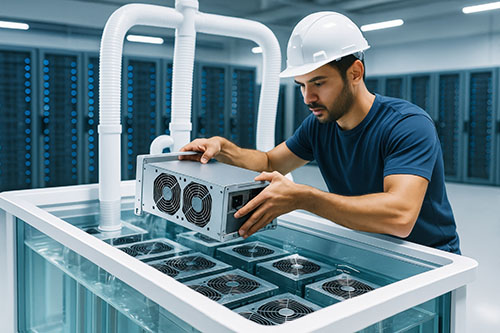
Immersion Cooling is the fastest growing method, and as suggested, entire servers are submerged in a special non-conductive liquid via two approaches:
- Single-Phase – Liquid absorbs the heat and pumped through a heat exchanger.
- Two-Phase – Liquid boils on hot components, converts to a vapor, then condenses back to liquid.
Pumps, valves, plastics, controls, tubing, fasteners all play a role in a cooling system and each of these are required to be free of contamination, debris and dust. Some of the best products aiding in product protection of cooling center components are flange covers. Learn more about flange covers.
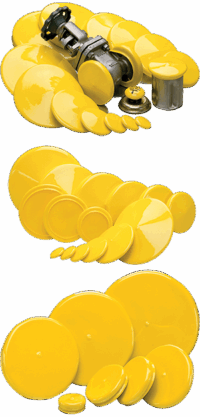
Browse our products and learn more about materials, styles and sizes and more. Each style will display sizes available and many items are linked to the online store for easy purchase. Remember, larger quantities are often supported by price breaks. Let us provide a quote – free quoting, free samples and free consultation are all available by submitting the request form or reaching our Specialists by phone, at 800-827-2277.